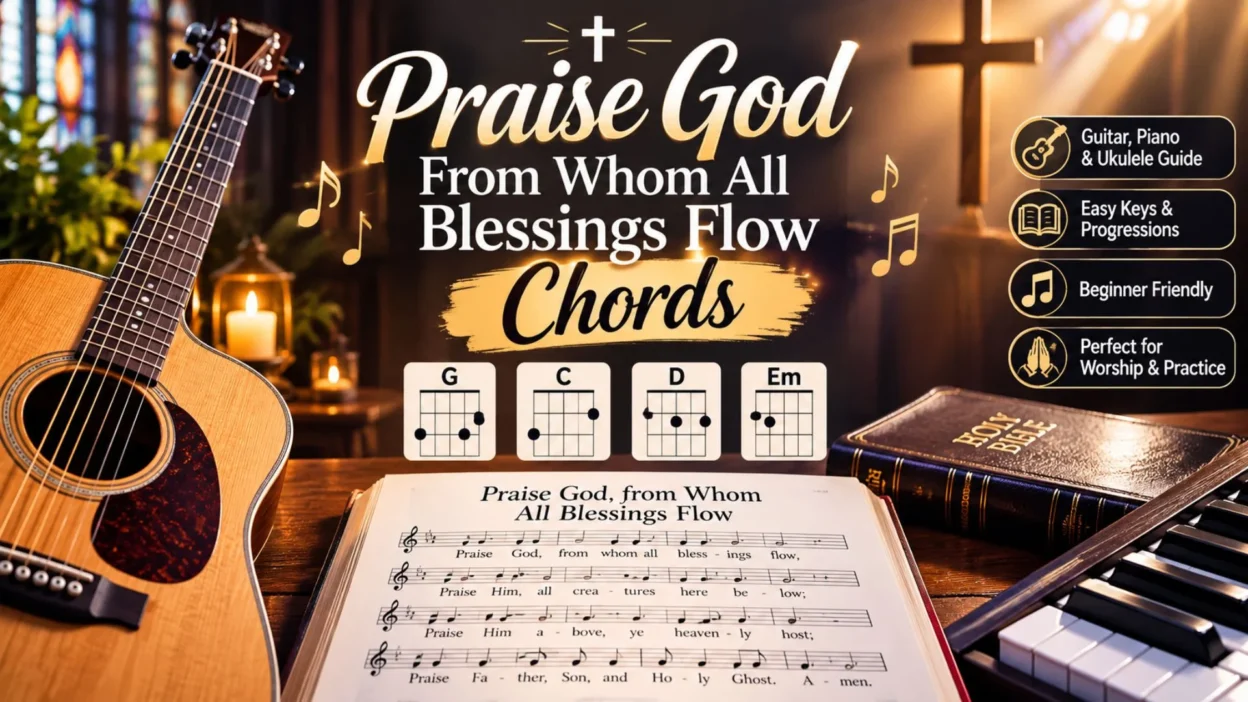
Praise God from whom all blessings flow chords are a great starting point for anyone who wants to play this classic Christian doxology on guitar, piano, or ukulele. The hymn is traditionally associated with Thomas Ken’s words and the Old 100th tune.
The good news is that you do not need a complicated arrangement to get started. Several simple chord versions are available, and you can choose a key that fits your instrument and singing range.
This guide explains the common chord progressions, beginner-friendly options, practice tips, and ways to transpose the hymn for worship or personal playing.
What Are the Praise God From Whom All Blessings Flow Chords?
The exact chords depend on the arrangement and key you choose. A commonly published guitar arrangement in G major uses G, D, Em, Bm, C, F#dim, Am, and D7.
A simpler beginner arrangement can use only a few major chords, making it easier for new guitar players to learn. One guitar lesson identifies D, G, and A as basic chords for a simplified version.
For beginners:
- 🎸 Start with three or four chords.
- 🎵 Learn the melody separately.
- 🙏 Keep the rhythm steady.
- 🔄 Practice chord changes slowly.
- 🎹 Choose a comfortable key.
- 🎤 Match the key to your voice.
- 📖 Learn the hymn’s basic structure.
- ⏱️ Increase speed only after accuracy improves.
The most important point is that there is no single mandatory chord chart for every performance. Different arrangements may use different harmonies while preserving the recognizable tune.
Praise God From Whom All Blessings Flow Chords in G
The key of G major is one of the useful options for guitar players. A detailed G arrangement includes G, D, Em, Bm, C, F#dim, Am, and D7.
A simplified progression may reduce the number of chord changes. That makes the song easier to play while you become comfortable with the melody.
A beginner can approach the G arrangement like this:
- G provides the home chord.
- D creates movement.
- Em adds a softer minor sound.
- Bm adds harmonic color.
- C provides another major harmony.
- Am can lead naturally toward D.
- D7 creates stronger resolution.
- F#dim appears in some fuller arrangements.
If you are new to guitar, do not worry about learning every chord immediately. Start with the basic progression and add the more advanced chords later.
Easy Guitar Chords for Beginners
Learning Praise God from whom all blessings flow chords does not have to be difficult. The best approach is to begin with a simplified arrangement.
For example, a beginner-friendly version may focus on familiar major chords such as G, D, and C. Another published beginner lesson uses D, G, and A as its basic chord foundation.
Try this practice method:
- 🎸 Learn one chord at a time.
- Hold each chord cleanly.
- Change between two chords slowly.
- Practice without singing first.
- Add the melody afterward.
- 🎵 Use gentle downstrokes.
- Keep a steady beat.
- Record yourself occasionally.
Do not rush through the chord changes. A slow, clean performance sounds much better than a fast performance with missed notes.
Guitar Chord Progression and Rhythm
The rhythm should support the hymn rather than overpower it. Because this is a traditional worship hymn, a simple and steady accompaniment often works very well.
You can begin with four even beats per measure. Once the changes feel comfortable, experiment with a gentle strumming pattern.
Helpful ideas include:
- Start with simple downstrokes.
- Count evenly while practicing.
- Avoid changing tempo during chord transitions.
- 🎶 Let important words receive natural musical emphasis.
- Use lighter strums during quieter moments.
- Practice the progression without vocals.
- Add vocals only when the hands feel comfortable.
- 🎸 Try fingerpicking after mastering basic strumming.
The traditional melody is often connected with the Old 100th tune, which has a long history in Christian worship.
Piano Chords for the Doxology
Piano players have a major advantage because chords can be played in several voicings. You can use simple triads first and later add seventh chords or passing harmonies.
If you are beginning, play the root position of each chord with your left hand and the full triad with your right hand.
A simple practice setup could include:
- 🎹 Left hand: root note.
- 🎹 Right hand: major or minor triad.
- G major: G-B-D.
- D major: D-F#-A.
- C major: C-E-G.
- E minor: E-G-B.
- A minor: A-C-E.
- D7: D-F#-A-C.
- Practice each transition separately.
Chord charts for the hymn are available in multiple keys, including C, D, E, F, G, A, B, and several flat and sharp keys.
That makes it easier to select a key that works for your congregation or vocal range.
Ukulele Chords and Simple Arrangements
Ukulele players can also use Praise God from whom all blessings flow chords with a simplified approach. Since ukulele arrangements often favor accessible chord shapes, beginners can start with the most common major and minor chords in their selected key.
Keep the accompaniment light and consistent.
Try these ideas:
- 🎵 Practice chord shapes separately.
- Change chords without strumming.
- Add a slow down-up pattern.
- Keep your wrist relaxed.
- Listen for buzzing strings.
- Practice difficult transitions repeatedly.
- 🎸 Use a metronome if helpful.
- Play along with a singer once comfortable.
The hymn is listed for multiple instruments, including guitar, ukulele, and piano, so it can work well in different musical settings.
Choosing the Best Key for Your Voice
The best key is not necessarily the key shown on the first chord chart you find. The right key is the one that allows the singer to perform comfortably.
For example, you might start in G and discover that the melody sits too high or low. In that case, transpose the chords.
Consider:
- 🎤 Your comfortable singing range.
- The lowest note you can sing easily.
- The highest note you can sing comfortably.
- The instrument you are using.
- The skill level of the musicians.
- The congregation’s singing range.
- Whether a capo can simplify guitar playing.
- Whether the new key creates easier chord shapes.
Published chord resources confirm that the hymn can be presented in many different keys.
How to Transpose the Chords
Transposing means moving the entire song into another key while keeping the relationships between the chords the same.
Suppose your arrangement uses:
- G
- C
- D
- Em
You can move the entire progression upward or downward by the same musical interval.
For guitar players, a capo can sometimes provide an easier way to change the sounding key without learning completely new chord shapes. A guitar tutorial for a newer doxology arrangement, for example, demonstrates using a capo to move an E-based shape into another sounding key.
When transposing:
- Keep every chord relationship consistent.
- Move all chords by the same interval.
- Check the singer’s range.
- 🎸 Consider using a capo.
- 🎹 Choose comfortable piano inversions.
- Practice the new progression slowly.
- Avoid changing only one chord.
- Test the complete song before performing.
The History Behind the Hymn
The words commonly known as the Doxology were written by Thomas Ken, while the familiar melody is traditionally associated with the Old 100th tune.
The hymn is widely recognized because of its short, memorable structure and its use in Christian worship.
Understanding the background can make learning the music more meaningful. Instead of treating the piece as only a chord exercise, musicians can see it as a historic expression of praise.
Its central theme is gratitude directed toward God as the source of blessing.
That simple message is one reason the hymn continues to appear in worship settings.
A Simple Practice Plan
If you are learning Praise God from whom all blessings flow chords for the first time, avoid trying to master everything in one session.
Use a short practice routine:
- 🎸 Day 1: Learn the basic chord shapes.
- 🎵 Day 2: Practice two-chord transitions.
- 🎹 Day 3: Play the complete progression slowly.
- 🎤 Day 4: Add the melody or vocals.
- 🎶 Day 5: Practice rhythm.
- 🙏 Day 6: Play it as a complete hymn.
- 📱 Day 7: Record and review your performance.
You can repeat this cycle as needed. The goal is not speed. The goal is confidence, clean transitions, and a steady musical flow.
Common Mistakes When Playing the Hymn
Even simple hymns can become difficult if you focus on too many things at once.
Watch for these common problems:
- Changing chords too quickly.
- Losing the beat during difficult transitions.
- Using overly complicated strumming.
- Choosing a key that is uncomfortable to sing.
- Trying advanced chords too early.
- Ignoring rhythm while learning chord shapes.
- Playing louder than the singer.
- Forgetting to practice the ending.
If you make a mistake, stop and isolate that small section. Repeating the difficult transition several times is usually more effective than playing the entire song repeatedly.
Using the Chords in Church Worship
The hymn can work well as a simple congregational song because its melody is familiar and its structure is short.
For worship musicians, simplicity is often useful. The accompaniment should help people sing rather than compete with them.
A worship arrangement might include:
- 🎹 Piano for harmonic support.
- 🎸 Acoustic guitar for rhythm.
- 🎤 A vocalist leading the melody.
- 🎵 Gentle instrumental introduction.
- 🙏 A clear ending for congregational timing.
- 🎶 Simple chord voicings.
- 🔊 Moderate volume.
- ❤️ A calm, respectful performance.
You can also adjust the arrangement depending on the size of the group. A solo performer may use basic chords, while a larger worship team can add additional harmonies.
Where to Find Chord Charts and Sheet Music
Several online resources provide chord charts or music information for this hymn. ChordLines publishes a G-major guitar arrangement, while PraiseCharts lists chord charts and multiple available keys.
A dedicated guitar lesson from JG Music Lessons also explains basic chords and arrangement concepts for players learning the piece.
When comparing charts:
- Check the key.
- Check the instrument.
- Look for the arrangement level.
- Compare chord substitutions.
- Confirm whether a capo is required.
- Choose a version matching your skill.
- 🎸 Avoid overly advanced charts at first.
- 📖 Use sheet music when you need the melody.
Because different arrangements exist, two legitimate chord charts may not look identical.
Frequently Asked Questions
What are the easiest Praise God from whom all blessings flow chords?
For beginners, a simplified arrangement using a few familiar major chords is usually easiest. Published beginner guitar material presents D, G, and A as a basic chord foundation.
What key is Praise God from Whom All Blessings Flow usually played in?
G major is one commonly published guitar keys, but the hymn can be transposed into many other keys. Chord resources list numerous available keys.
Is the hymn easy to play on guitar?
Yes. A simplified version can be accessible to beginners, especially when you learn a few basic chords first and add more advanced harmony later.
Can I play it on piano?
Yes. Piano works especially well because you can use simple triads or fuller chord voicings. Published resources specifically include piano arrangements.
Can I play the hymn on ukulele?
Yes. Chord charts are available for ukulele, and a simplified arrangement can be adapted for beginner players.
Who wrote the Doxology?
The familiar words are attributed to Thomas Ken, and the melody is associated with the Old 100th tune.
Why do chord charts use different chords?
Different musicians create different arrangements. Some use simple harmony for beginners, while others include additional chords for a fuller sound.
Can I change the key?
Yes. Transposition allows you to move the song to another key. This can help match a singer’s comfortable range or make the chord shapes easier.
Final Thoughts
Learning Praise God from whom all blessings flow chords can be a rewarding way to combine music with worship. You do not need an advanced arrangement to begin. Start with simple chords, establish a steady rhythm, and gradually add more detailed harmony.
For guitar, G is a useful starting point, while other keys may be better depending on the singer and instrument. Piano and ukulele players can also adapt the hymn using accessible chord shapes. Published resources show that the song is available in a wide range of keys and arrangements.
Most importantly, focus on playing with confidence rather than trying to make the arrangement complicated. A simple, steady performance can beautifully support the timeless message of praise and gratitude.

Olivia Brooks is a dedicated writer and content creator who focuses on sharing heartfelt blessings, meaningful prayers, and uplifting messages. With a deep belief in the power of words, she aims to inspire hope, faith, and positivity in everyday life. Through her work, Olivia creates a calming space where readers can find comfort, encouragement, and spiritual connection.