
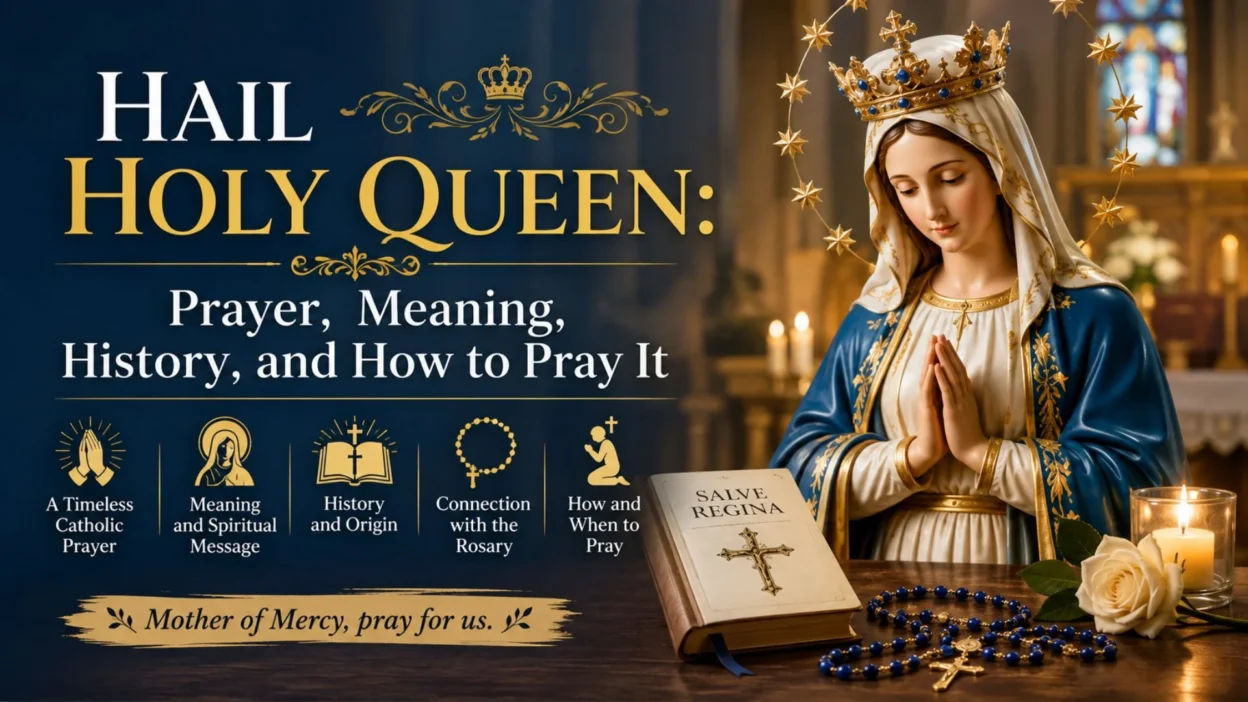
The Hail Holy Queen is one of the best-known Marian prayers in Catholic tradition. Also called the Salve Regina, it turns the heart toward the Blessed Virgin Mary as Mother of Mercy and asks for her loving intercession as we journey toward Jesus.
For many Catholics, this prayer is especially familiar because it traditionally concludes the Rosary. It is also used in Catholic prayer and liturgical traditions at different times of the year. The United States Conference of Catholic Bishops presents it as the traditional “Hail, Holy Queen” or “Salve Regina,” while Vatican News also includes it among its Catholic prayers.
The prayer speaks honestly about human struggles while keeping its focus on hope. Its words recognize sorrow, weakness, and the difficulties of earthly life, yet they end by directing attention toward Jesus.
If you are learning the Hail Holy Queen, returning to it after a difficult day, or looking for a deeper understanding of the prayer, this guide explains its meaning, history, Rosary connection, and spiritual message.
What Is the Hail Holy Queen?

The Hail Holy Queen is a traditional Marian prayer known in Latin as the Salve Regina, meaning “Hail, Queen.” It addresses Mary as Queen and Mother of Mercy and asks for her intercession.
The prayer is deeply connected with Catholic devotion to Mary. Rather than stopping with Mary, its final focus points toward Jesus, described as the blessed fruit of her womb.
Here are some key facts:
- 🙏 It is a traditional Catholic Marian prayer.
- 🌹 Its Latin name is Salve Regina.
- ✝️ It is traditionally prayed at the end of the Rosary.
- ❤️ Mary is addressed as Mother of Mercy.
- 🌿 The prayer speaks openly about human suffering.
- 🕊️ It expresses trust and hope.
- 👑 Mary is honored as Queen.
- ✨ The prayer ultimately directs attention toward Jesus.
The Hail Holy Queen is therefore more than a memorized prayer. For Catholics, it can become a moment of trust, reflection, and hope.
The Hail Holy Queen and the Rosary
One of the most familiar places to encounter the Hail Holy Queen is at the conclusion of the Rosary.
After meditating on the mysteries of Christ’s life, Catholics traditionally turn to Mary with this prayer. The transition is meaningful: the Rosary has focused on Jesus, and the closing Marian prayer asks for Mary’s intercession while again pointing toward her Son. Catholic resources describe the prayer as a customary conclusion to the Rosary.
When praying the Rosary, the Hail Holy Queen can serve as:
- 🙏 A final prayer of trust.
- ❤️ A request for Mary’s intercession.
- ✝️ A reminder to remain close to Christ.
- 🌿 A peaceful ending to meditation.
- 🕊️ A moment to surrender worries.
- 🌹 An expression of Marian devotion.
- ✨ A reminder of Christian hope.
- 👑 A way to honor Mary as Queen.
This connection makes the prayer especially meaningful for people who pray the Rosary regularly.
What Does Hail Holy Queen Mean?
At its heart, the Hail Holy Queen is a prayer of mercy, hope, and intercession.
The opening calls Mary “Mother of Mercy” and describes her as a source of life, sweetness, and hope. The prayer then acknowledges the pain and struggles of human existence. Finally, it asks Mary to turn her merciful attention toward those who call upon her and to show them Jesus.
Its central ideas include:
- ❤️ Mercy: We turn toward a compassionate mother.
- 🌿 Hope: The prayer does not end in despair.
- 🙏 Intercession: Catholics ask Mary to pray for them.
- ✝️ Christ: The prayer ultimately leads attention to Jesus.
- 🕊️ Comfort: Human suffering is honestly acknowledged.
- 🌹 Trust: The faithful place their concerns before God.
- 👑 Mary’s queenship: Mary is honored as Queen.
- ✨ Eternal hope: Earthly difficulties are not presented as the final destination.
This combination of honesty and hope helps explain why the prayer has remained meaningful for generations.
Why Is Mary Called Mother of Mercy?
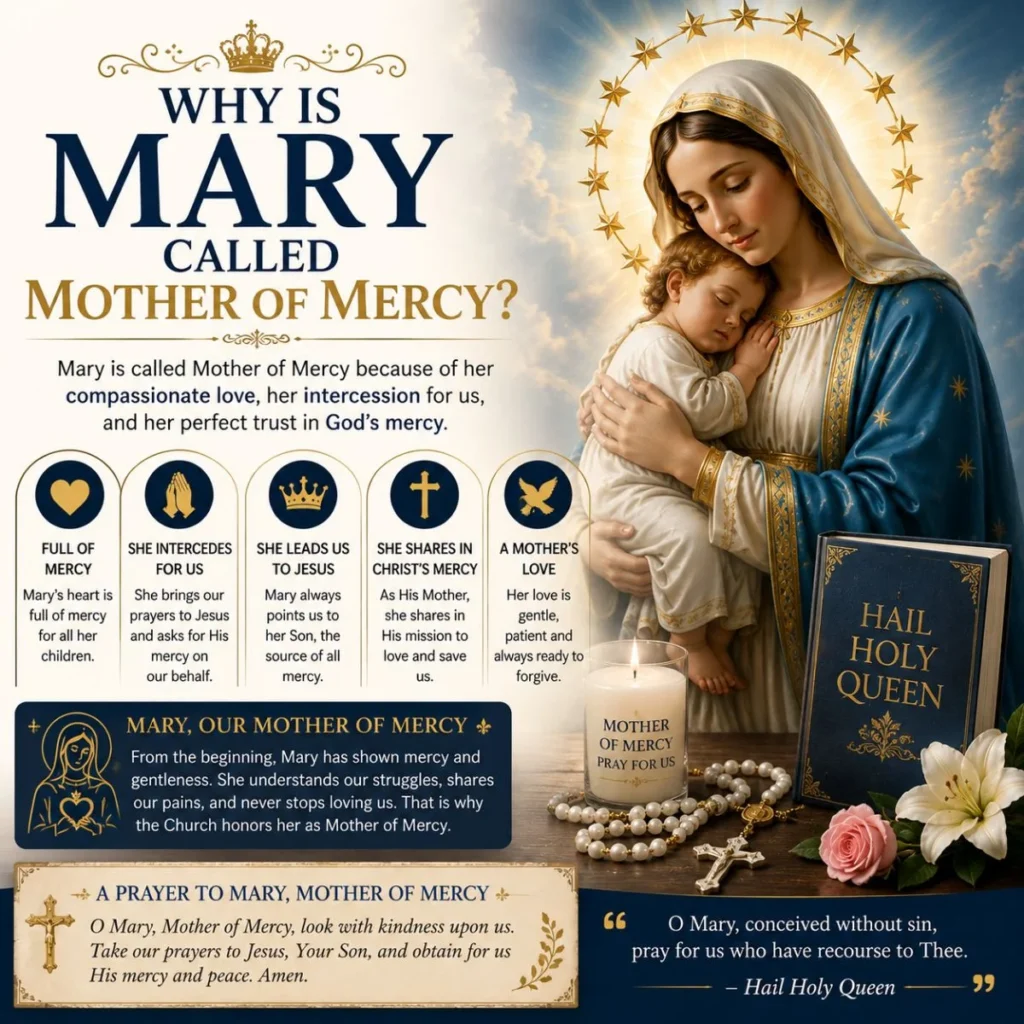
The title Mother of Mercy is central to the Hail Holy Queen.
Catholic devotion understands Mary as the mother of Jesus and a loving spiritual mother who points people toward her Son. The title emphasizes compassion rather than power. It invites people who are struggling to approach prayer with confidence and humility.
Consider these reflections:
- ❤️ Mercy welcomes the person who is hurting.
- 🙏 Mercy encourages sincere prayer.
- 🌿 Mercy gives room for repentance.
- 🕊️ Mercy brings comfort during difficult seasons.
- ✝️ Mercy points believers toward Christ.
- 🌹 Mercy reminds us that we are not alone.
- 👑 Mercy is central to Mary’s traditional title.
- ✨ Mercy gives hope when life feels heavy.
The prayer therefore speaks naturally to people experiencing grief, uncertainty, disappointment, or spiritual dryness.
What Does “Valley of Tears” Mean?
One of the most memorable images in the Hail Holy Queen is the reference to a “valley of tears.” The phrase expresses the reality that earthly life can contain suffering, loss, disappointment, and hardship.
It does not mean that Christian life is supposed to be hopeless. Instead, it recognizes suffering while looking beyond it toward God’s promises.
The phrase can invite personal reflection:
- 🌧️ What difficulty am I carrying today?
- 🙏 Where do I need God’s help?
- ❤️ Who needs my prayers?
- 🕊️ Where can I choose hope?
- 🌿 What burden can I surrender?
- ✝️ How can I draw closer to Christ?
- 🌹 What blessing can I still recognize?
- ✨ What am I trusting God to guide me through?
For someone having a difficult day, these simple questions can turn the prayer into a personal moment of reflection.
When Should You Pray the Hail Holy Queen?
There is no need to wait for a particular crisis before praying the Hail Holy Queen. Catholics may encounter it through the Rosary, liturgical prayer, Marian devotion, or personal prayer.
Traditional Catholic sources also connect the Salve Regina with evening prayer and the liturgical year. EWTN and the Marians of the Immaculate Conception describe its traditional use as a Marian antiphon during a particular part of the liturgical year.
You might pray it:
- 🌅 During morning prayer.
- 🌙 During evening prayer.
- 🙏 At the end of the Rosary.
- ❤️ During a difficult season.
- 🕊️ When seeking peace.
- 🌿 During personal reflection.
- ✝️ As part of Marian devotion.
- 👑 On the Feast of the Queenship of Mary.
The best time is often the time when you can pray slowly and sincerely.
The History of the Salve Regina
The Salve Regina has medieval roots and has been part of Christian devotion for centuries. Its exact authorship is not completely settled.
Some traditions have attributed the prayer to the eleventh-century monk Hermann of Reichenau, while other historical accounts give different attributions. Modern discussions therefore treat its authorship with caution rather than presenting one attribution as certain.
What is clearer is its lasting place in Catholic prayer.
Over the centuries, the Salve Regina became associated with:
- 📜 Medieval Christian prayer.
- 🎵 Sacred music and chant.
- 🙏 Marian devotion.
- ⛪ Catholic liturgical traditions.
- 🌙 Evening prayer.
- 🌹 The Rosary.
- ✝️ Reflection on Christ.
- 👑 Devotion to Mary as Queen.
Its long history is one reason the prayer remains familiar to Catholics around the world.
Why Is August 22 Important for the Hail Holy Queen?

August 22 is the Feast of the Queenship of Mary in the Catholic calendar. Loyola Press specifically highlights August 22 as the day Catholics celebrate this feast.
This makes the Hail Holy Queen especially fitting for reflection around this date because the prayer directly addresses Mary as Queen.
The feast can be a meaningful opportunity to:
- 👑 Reflect on Mary’s queenship.
- 🙏 Pray the Hail Holy Queen.
- 🌹 Pray the Rosary.
- ❤️ Ask for Mary’s intercession.
- ✝️ Reflect on Mary’s relationship to Jesus.
- 🕊️ Pray for peace in your family.
- 🌿 Remember people who need comfort.
- ✨ Renew your hope in God.
Because the feast occurs every year, this is a useful seasonal element without turning an evergreen article into a year-specific post.
A Simple Way to Pray the Hail Holy Queen
If you are new to the prayer, you do not need to rush. The Hail Holy Queen can be prayed slowly, with attention to each idea.
Try this simple approach:
- 🙏 Find a quiet place.
- ✝️ Begin with the Sign of the Cross.
- 🌿 Take a slow breath and become still.
- ❤️ Think about the meaning of “Mother of Mercy.”
- 🕊️ Bring your worries honestly into prayer.
- 🌹 Ask Mary to intercede for you.
- ✨ Focus your heart on Jesus.
- 🙏 End with a moment of quiet gratitude.
If you are praying the Rosary, the prayer traditionally comes after the five decades and serves as a closing Marian prayer.
The goal is not simply to say every word quickly. A slower prayer can give you more time to reflect on what the words mean.
A Short Reflection on the Hail Holy Queen
The beauty of this prayer is its movement from struggle toward hope.
Life can sometimes feel uncertain. People face family concerns, grief, loneliness, disappointment, fear, and questions about the future. The Hail Holy Queen does not pretend these experiences do not exist.
Instead, it gives those struggles a place within prayer.
Consider this short reflection:
Mary, help me bring my worries to God with trust. Help me remain hopeful when life feels difficult, and guide my heart toward Jesus.
This kind of reflection can make a familiar prayer feel personal again.
What Makes the Hail Holy Queen So Powerful?

The word “powerful” does not have to mean dramatic. The Hail Holy Queen can feel powerful because it gives language to emotions that many people already carry.
It combines several important themes:
- ❤️ Compassion for those who suffer.
- 🙏 Trust in God’s care.
- 🌿 Hope during hardship.
- ✝️ Attention toward Jesus.
- 🌹 Marian devotion.
- 🕊️ A request for intercession.
- 👑 Reverence for Mary.
- ✨ Confidence in eternal hope.
The prayer is also simple enough to become part of a regular routine.
Over time, familiar words can take on deeper meaning because life changes. A person may pray the same prayer during peaceful days, difficult days, joyful celebrations, and seasons of grief.
The words remain familiar, but the heart praying them may be experiencing something completely different.
Hail Holy Queen vs. Hail Mary
The prayer speaks honestly about human struggles.
It recognizes sorrow and weakness along the journey.
Ultimately, the words point the heart toward Jesus.
Here is a simple comparison:
- 🙏 Hail Mary: Frequently repeated during each Rosary decade.
- 🌹 Hail Holy Queen: Traditionally used to conclude the Rosary.
- ❤️ Hail Mary: Focuses on Mary and asks for her prayers.
- 👑 Hail Holy Queen: Addresses Mary as Queen and Mother of Mercy.
- ✝️ Both: Direct Christian devotion toward Christ.
- 🕊️ Both: Ask for Mary’s intercession.
- 🌿 Both: Have a long place in Catholic prayer.
- ✨ Both: Can become part of personal devotion.
Knowing the difference can help someone who is learning the Rosary understand where each prayer fits.
Frequently Asked Questions About Hail Holy Queen
What is the Hail Holy Queen?
The Hail Holy Queen, or Salve Regina, is a traditional Catholic Marian prayer honoring Mary as Queen and Mother of Mercy. It is especially known as the closing prayer of the Rosary.
What does Salve Regina mean?
Salve Regina is Latin for “Hail, Queen.” It is the traditional Latin name of the Hail Holy Queen.
Is the Hail Holy Queen part of the Rosary?
Yes. It is traditionally prayed at the conclusion of the Rosary. Catholic sources identify it as a customary closing prayer.
Why do Catholics pray the Hail Holy Queen?
Catholics pray it as an expression of Marian devotion and to ask for Mary’s intercession. The prayer also acknowledges human suffering while expressing hope and directing attention toward Jesus.
Is the Hail Holy Queen biblical?
The prayer itself is a traditional Christian prayer rather than a direct quotation from one Bible passage. However, it uses themes deeply connected with Catholic biblical theology, including Mary as the mother of Jesus, mercy, hope, and Christ as the center of salvation.
When is the Feast of the Queenship of Mary?
The Feast of the Queenship of Mary is celebrated on August 22.
Can I pray the Hail Holy Queen outside the Rosary?
Yes. While it is especially associated with the Rosary, it can also be used in personal prayer and other Catholic devotional settings.
What is another name for the Hail Holy Queen?
Its traditional Latin name is Salve Regina.
Final Thoughts on the Hail Holy Queen
The Hail Holy Queen remains a beloved Catholic prayer because it speaks to both suffering and hope. It recognizes that life can feel like a difficult journey, yet it does not leave the person praying without direction.
Its message is ultimately one of trust.
Mary is honored as Queen and Mother of Mercy, while the prayer’s attention turns toward Jesus. For Catholics, that makes the prayer a meaningful way to close the Rosary, reflect during difficult moments, or spend a few quiet minutes in devotion.
Whether you have prayed it for years or are discovering it for the first time, take your time with the Hail Holy Queen. Let its themes of mercy, hope, intercession, and Christ-centered faith become more than familiar words.
And on August 22, the Feast of the Queenship of Mary offers a natural annual opportunity to remember this beautiful Marian prayer and reflect on Mary’s place in Catholic devotion.wide 16:9 composition, no text.

Olivia Brooks is a dedicated writer and content creator who focuses on sharing heartfelt blessings, meaningful prayers, and uplifting messages. With a deep belief in the power of words, she aims to inspire hope, faith, and positivity in everyday life. Through her work, Olivia creates a calming space where readers can find comfort, encouragement, and spiritual connection.